Search This Blog

Wednesday, October 19, 2011

The iPad 2 Competition Winner

Ok, here's how it was judged. I downloaded all the entries into a spreadsheet, deleted a small number of invalid entries (ie those not from Australia), and ended up with 1057 valid entries, numbered from 1 to 1057.


I then obtained a random number sequence from 1 to 1057 using the Sequence Generator at www.random.org. The first number in the sequence is the winner. 


That number is 1003.


And the winner is Zac Mac, who has been notified. Congratulations, Zac.


And commiserations everyone else. But never fear, I may run a third iPad comp in a few months time.


Thanks for entering.


Saturday, October 15, 2011

The Truth About Publishing – 6


Lesson 5: Why most writers never get published
If you’re continually being rejected, it’s time for ruthless self-analysis. These are the most common reasons that fiction manuscripts are rejected:
  • The writer simply can’t write – or, just as commonly, hasn't taken the trouble to learn how to write;
  • The writer has written a first draft and submitted it without bothering to edit it. No professional would submit a first draft;
  • The storyline and characters are directly recycled from well known novels, TV shows, movies or computer games;
  • It’s not a story, just a series of unrelated events; or it’s a polemic or rant, or a poorly disguised religious tract
  • It’s grossly violent, libellous, pornographic, depraved or offensive, or off-the-planet weird;
  • It’s not appropriate for the publisher you sent it to, or their publishing schedule is already full; or
  • The public simply aren’t buying that kind of stuff at the moment.

Listen to what people are telling you about your work. If you do have talent, take the advice of professionals and you’ll immediately have an edge over most of your competitors, because few unpublished writers are really willing or able to act on criticism.
For more details on all of the above points, see my post What Publishers Hate, http://ianirvine.blogspot.com/2011/09/what-publishers-hate.html.
My next post deals with what to do when you are offered a contract.


Thursday, October 13, 2011

Stephen M Irwin on The First Step


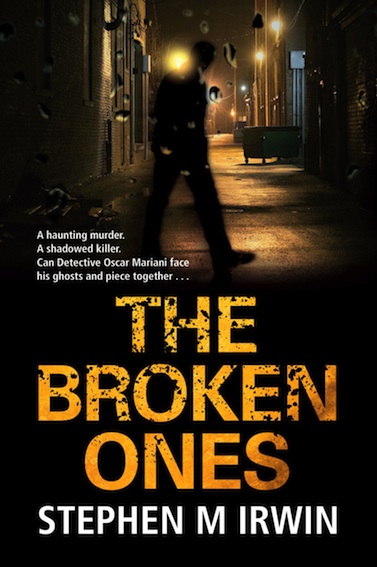
Today’s guest blog is from Stephen M Irwin, novelist and filmmaker whose short films have won awards around the world.  He has written and directed TV documentaries and his first novel, The Dead Path, which has been published in many countries, was named Top Horror Title in the 2011 RUSA Reading List.  His second novel, The Broken Ones, was released in Australia to excellent reviews in August this year.  Stephen works as a story consultant for Australian producers, and has a long creative association with beyondblue: the nation depression initiative.

My daughter is about to take her first steps.  She turned one in August, and over the last week or so has gained the confidence and ability to stand for up to a minute unaided.  She still needs an adult’s fingers to lean on as she walks, but we know it is only a matter of days before she starts walking by herself.  And we know, too, that she will only be able to take a few steps at a time before she will fall, again and again, as she learns a skill that will carry her across rooms and paddocks, city squares and sandy beaches, frozen lakes and airport terminals – rocket terminals, maybe.
            As I walk behind her, bent over, her fingers gripping mine, I’m reminded acutely of the description that “walking is controlled falling”.  Perhaps it was on one of the wonderful Lord Robert Winston’s documentaries that I first heard this (it doesn’t matter).  Watching Poppy lean and shuffle and delight in self-mobilisation, I am struck by the similarities between walking and storytelling.  Or running and storytelling (again, it doesn’t matter).  When one first begins writing stories, the first paragraphs – those first steps –  feel perilously unsteady and untrustworthy, and often with good reason.  But with practice and not a few falls the steps grow more confident, and self-mobilisation becomes a possibility.  Journeys become a possibility: storytelling become something achievable, if you can just place one paragraph steadily after the next. 
            But bless the falls, and bless the perils. 

            As a person relatively new to novel writing, I must remind myself not to forget them, because good stories are not safe journeys.  Be they short story sprints, or novel-length marathons, or trilogy treks, they should never be secure and uneventful; quite the opposite: every step must be fraught with the danger of a fall.  And indeed those falls must come, and if the author’s job is done well, the reader will go down the avalanche with the characters, willingly and delightedly. 
            Here is the rub for the storyteller.  She or he must write in such a way that the readers feel in such safe hands they are prepared to go anywhere; the paragraphs and component sentences must be easy to read and solid.  Yet, those very paragraphs and sentences must be ready to betray their subject and the reader, to slide away unexpectedly.  For why else do we read, but to be surprised?  Is there any better reason not to read than to be presented with fresh text and yet know exactly what will happen next?  The storyteller must both know the route and keep it hidden.  The storyteller must be the hands the readers hold, allowing the readers to feel they’re in control while actually guiding them on a surprising path into new places, bright and dark.  Every step must be controlled, yet every step must hold the promise a fall.
            Pacing, of course, is a skill that improves with practise.  The author learns not to place the dramatic moments (the missteps, stumbles and tumbles) too closely together, or to space them too widely, lest the reader become exhausted or (worse) bored. 
            Ultimately, a destination will be reached – the ending.  It may be utterly unexpected by the reader, and that will delight.  It may be anticipated, but if so will hopefully be greeted with a glowing thought: ‘I suspected that might happen’.  But if the journey itself has been carefully sown with enough uncertainty, even an ending the reader predicted won’t feel so, and so will satisfy.   The ending is important, but the journey is everything.
            It starts with a treacherous, rock-solid step.


Thanks, Steve. Steve’s website is www.stephenmirwin.com


Wednesday, October 12, 2011

The Truth About Publishing – 5


Lesson 4: What to do when you’re rejected

Once you’ve done all that, and been rejected, send your work to another publisher right away. After all, it’s just one editor’s opinion and what one editor hates, another may love. If you’ve sent it to ten publishers and they’ve all rejected it, it’s time to rewrite it. If you’ve sent it to twenty, chuck it away and start again. If forty, assuming you can find that many publishers, write something completely and utterly different and change your name.
To experience the extraordinary diversity of opinions any work will get, check out the reader reviews, for any book you know well, on Amazon. For a laugh, take a look at what eighty-odd readers say about my first book, A Shadow on the Glass. One reader will attack the book, the author, editor, proof-reader, publisher and everyone else associated with it, as if mere publication of this book was a personal insult. The next reader will say it’s the best book they’ve ever read. For my own amusement, I once matched up a dozen professional reviewers comments on this book into pairs that contradicted each other.
Don’t take rejection to heart. I once had my editor knock back a manuscript as ‘unpublishable’. A fortnight later my agent sold it to another publisher for lots of money and they offered me a three-book contract into the bargain. The series had terrific reviews and I did about a hundred interviews, quite a few of them for national media so, even though sales were modest, the books and the publicity lifted my author profile tremendously.
But if none of the above is working, tomorrow’s post, Why most writers never get published, may tell you why.


Tuesday, October 11, 2011

The Truth About Publishing – 4


Lesson 3: Skiing across the slush pile

In this country, the big publishers each receive 3-5,000 unsolicited fiction manuscripts a year. That’s around a hundred a week. The situation is much the same in the UK, Canada and the US – publishers receive an absolute deluge of manuscripts week in and out, even when they state that they’re not accepting unsolicited manuscripts.
Publishing is a competitive and low profit business, and no publisher can afford to pay people to read all those manuscripts. Many publishers simply return them if postage is provided, or shred them if it isn’t. Where they do look at manuscripts, it will only be the professionally presented ones – perhaps half the total. Of that 2,500, say, 90% will be rejected on the first page and 98% by the end of the first chapter. That leaves 30-50 manuscripts, and they’re the only ones that will receive serious consideration. In a good year, ten of those might be published (out of the original 5,000). In a bad year, less than five.
Most published books come through agents, but no agent can afford to spend a lot of time reading manuscripts from unknowns either. Most agents won’t even look at an unsolicited manuscript and again, most manuscripts an agent does consider will be rejected on the first page. For the key faults a top NY agent sees in submitted manuscripts every day of the year, and how to fix them, see Don Maass’s terrific 2009 book, The Fire in Fiction.
The lesson is obvious: your story has to start in the first paragraph, with an interesting character facing some kind of problem that captures the reader’s interest or concern, and your very best writing has to be up front. Once you’ve done that, work on your contacts because agents get most of their manuscripts from referrals – it’s the only practicable way to filter out the few good books from the vast morass of manuscripts that aren’t publishable. Before you send your work off, make sure you follow the submission guidelines on the publisher’s website, and present your work in standard manuscript format. If you don’t, it’s likely to be discarded without another glance.
But how do you get your work in front of that agent or editor in the first place? Make contacts at book fairs, writers’ workshops and festivals, and other places where the industry gets together, then use them. Write to your contacts with your idea and perhaps a couple of sample pages (the first pages, obviously). If they like what they see, your manuscript is now a solicited one. It still won’t be published if it’s no good, but at least it’s at the top of the queue to be read.
For advice on those major Aussie publishers who are taking manuscripts, see my recent post: http://ianirvine.blogspot.com/2011/10/publishers-looking-for-manuscripts.html.


Sunday, October 9, 2011

The One-Page Guide to Storytelling

Here, gleaned from several decades of writing, experience doing my 27 novels, and the hundreds of books I've read on writing and storytelling, is the most concise guide to storytelling I can come up with. I've included some classic references at the end.


For each scene, and your overall story, answer these seven questions. If you can’t answer all of them, your story has a critical problem. If you can, you have the basis of a strong story.

1. What’s the Hero’s Goal? The hero must want something desperately (eg, to survive, to escape, win the girl or the contest, achieve his destiny or save the world). What is his goal, and why is he so driven to get it? The real story doesn’t start until your hero forms this urgent and powerful goal.

2. Who (or What) is the Opponent? The opponent must want to stop the hero just as strongly. Who is the opponent, and why is he, she or it so determined to defeat the hero?
  • The opponent can be a person (an enemy, or even an ally who thinks the hero is wrong), or an animal, monster, a force of nature (eg flood, fire), an organisation, or society itself.
  • Constantly ask yourself, How can things get worse? and When is the worst time for them to get worse? Then make it happen.
  • If the hero is having a good time, your readers aren’t.
  • Character is revealed by how the hero deals with adversity. The worse things get, the better it is.

3. How Does the Hero Fight Back? The hero must do everything possible to defend himself against the opponent, defeat it and achieve his goal. The opponent must fight back, just as strongly and cunningly, to defeat the hero.
  • Show their struggle vividly and dramatically, with progressively rising suspense until the climax.
  • Any scene that does not directly contribute to this struggle will come as an anti-climax.

4. What’s the Outcome? Every scene must have an outcome (a win or a loss), and so must the story.
  • Most scene endings (even if they seem like a win at the time) should result in the hero being in worse trouble.
  • The story ending should resolve the hero’s story goal, though not necessarily by achieving it. The ending can be a hollow or even disastrous victory, a compromise, or an outright loss. Or the hero may realise that he no longer wants the goal he so strove for.
  • How is the hero changed at the end, if he is? Note that some characters (especially in series) never change: eg James Bond, Stephanie Plum, Mr Bean.

5. What’s the Hero Feeling? Your readers can’t identify with the hero and worry about him unless you show his hopes, dreams, fears, dreads and conflicts at every stage of the story.
  • Don’t name emotions and feelings (eg, ‘He felt guilty.’). Show them the way that character would think, and in what he says and how he acts and reacts.
  • Your readers need to know the hero’s emotions (and how they’re changing) in every part of every scene.

6. Have you Shown, or are you Boring your Readers by Telling? Telling is the author talking at the reader. Showing is the protagonist revealing what’s happening at each moment, in his own words and actions, filtered through his own feelings, thus revealing his character. Also:
  • Have you shown the unique milieu, story world and setting (how Harry Potter differs to The Lord of the Rings, Casablanca, Gone With the Wind)? No reader wants a clichéd version of another author’s story world. Show the specific details of your world that make it unique.
  • Have you created a number of memorable, knee-to-the-groin images that bring the story alive?
  • Are you constantly looking for new twists to overturn clichéd characters, settings, dialogue, action scenes and plots?
  • Are your chapter beginnings and endings dull and repetitive, or striking, original and compelling?
  • Suspense is the lifeblood of story. Never tell the reader anything upfront when, by withholding it, you can create or heighten suspense.
  • Every interaction, between every character (even friends and allies) should contain conflict. But not meaningless conflict, or bickering – the conflict needs to be related to the hero’s goal: either furthering it or blocking it.
  • Do you use the minimum number of viewpoint characters needed to tell the story, and keep to a single viewpoint in each scene? If you clog your story with lots of ill-chosen viewpoint characters, and constantly shift viewpoints within scenes, you’ll confuse and annoy your readers.

7. Are your Characters Extraordinary, or Ordinary?
The characters in most manuscripts are weak, dull and forgettable. They fail from too little exaggeration, not too much.
  • Show your hero’s strengths, humanity and flaws vividly; the opponent should be equally strong (or preferably, stronger) and just as complex.
  • Bring out your hero’s strongly held attitudes, passions and beliefs. Have him rage, harangue, sneer, scream, mock, be sarcastic etc … Give each character a unique voice.
  • Don’t restrain your characters. Make them larger and louder than life. Heighten their reactions, emotions, language and imagery until they’re out of control. Have them say and do things that ordinary people never do. That’s why we like to read about them.


Some Great Storytelling References.

Noah Lukeman, The Plot Thickens. Terrific chapters on characterisation, suspense and conflict, a lot of stuff I’ve never thought of before.
Jerry Cleaver, Immediate Fiction. No one has ever explained the craft of storytelling more clearly or simply. A fantastic book.
Don Maass, The Fire in Fiction.  Chapter by chapter, Maass goes through the problems his NY literary agency sees thousands of times a year in almost every submitted manuscript, and in many books that get published, and tells you what to do about them. 
Elizabeth Lyon, Manuscript Makeover. The best book on self-editing, in my view.
John Vorhaus, The Comic Toolbox. Not just the best book on comic writing, but better than all the others put together. 

For more about me and my books: http://www.ian-irvine.com/
To say Hi, talk about books and writing or enter my Win an iPad 2 competition (closes October 15, 2011): http://www.facebook.com/ianirvine.author


Saturday, October 8, 2011

The Truth About Publishing – 3


Lesson 2: Anyone can do it, hah!

There’s a widely held assumption that writing a book can’t be all that hard. After all, everyone can write, can’t they? We write stuff every day of our lives.
At conventions and writing festivals I often meet people who assume writing is easy. They say, “I’m going to write a book one day when I get the time,” or “I’m going to take six months off and write a novel, then I’ll use the advance to write full time/go round the world/pay off the mortgage.”
No matter your command of English, writing a novel isn’t easy and, even after you’ve been doing it for a few years, you’re still a learner. If you want to be a successful writer, be prepared to work as hard, and as long, as if your ambition is to be a violinist in an orchestra, a professional cricketer or a brain surgeon. Rarely, someone will write a book and get it published straight away, but that’s unusual. I was once in a roomful of writers when that question was asked, and only 3 writers raised their hands. Most writers work for 5-10 years before getting their first novel published (my first took 9 years).
Remember the 10,000-hour rule, which has been around for decades if not centuries. 10K hours is roughly how much work and practice it takes to most people become truly accomplished in any field, whether it be sporting, creative or professional. Sure, there are exceptions, and geniuses, but look behind most geniuses and you’ll find a lot of perspiration. 10,000 hours is 5 years of full-time, focused hard work with no distractions or, more commonly, 7-10 typical working years. To become a virtuoso, triple that amount of work.
I’d done over 14,000 hours of fiction writing by the time my first series, The View from the Mirror, was published in 1998. But I’m slow.
I’m up to 40,000 hours now and I’m definitely not a virtuoso. I still hate my first drafts, and when I pick up any of my published books (usually based on the 10th draft, sometimes the 20th) I see things that could be done better on every page. I’m constantly reading about the art of storytelling, constantly studying it and how other writers write their novels, trying to gain new insights into how stories work and the best way to tell them, yet sometimes I feel I’m only scratching the surface. I’m amazed at how much there is to learn – yet excited, too.

Storytelling a wonderful way to make a living, and spend a life. I wish your all the best in your own efforts to master the craft.